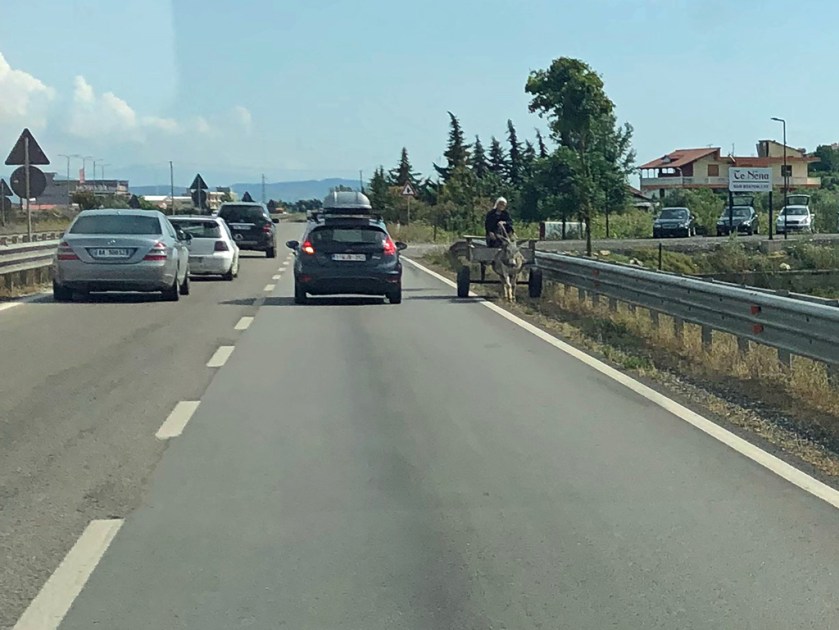
When mentioning that we we’re planning to drive through Albania, we got quite a few comments warning us about how dangerous it is to drive there. What I can say after having been there is the following: Albanians don’t drive as aggressive as we’d expect, but they certainly don’t follow the same rules as we are used to. For one, they never seem to remember that their car has got a blinker. You’ll never know if they suddenly decide to turn left or right (which they of course do). If they want to get something from a shop along the road, it’s never necessary to find a parking spot – they simply park their car on the road. When driving on the highway (2 lanes in both directions) with speed limit 90 km/h, you meet both donkey carriages, bicycles, motorcycles and people pushing a wheelbarrow, using your shoulder – driving or walking against traffic using parts of the lane.
Along the highway there’s gas stations every second kilometre, usually consisting of a restaurant, bar and hotel, often built in a very pompous style. With a car wash at every corner in the cities and even villages, it’s no surprise that all the Mercedes and other expensive cars on the roads are shining clean. And one thing is obvious: the car is the must-have number one status symbol here in Albania.
Coming from Montenegro, we reach the border at Sukobin in the late morning. There is a long queue of cars and it takes almost 2 hours until we can show our passports. The officer takes a quick look and waves us through, without even checking our car or trailer. We continue south to Durres, through the country side.


This part of Albania is certainly more developed than the rest of country. New building developments pop up along the road, both in and outside of the cities. It all seems chaotic, without an obvious area planning. And in between are the usual unfinished concrete structures, often partly inhabited, but never finished. What we really are shocked and disgusted about is the amount of garbage everywhere. There is not a single spot along the road without plastic bottles, cans, bags etc. It is worse than anything we’ve ever seen.
Next, we reach the harbour city Vlore, which seems a little more organised. Its beach front is lined with lots of new developments in form of hotels and apartment buildings, restaurants and bars. After one night in Radhime right by the sea (no swimming though since the beach is too littered) we continue along the coast. Unfortunately, the weather has turned, and it starts raining after breakfast. Crossing the Llogara Pass we don’t see much of this supposedly beautiful National Park since we’re mainly driving through thick fog.
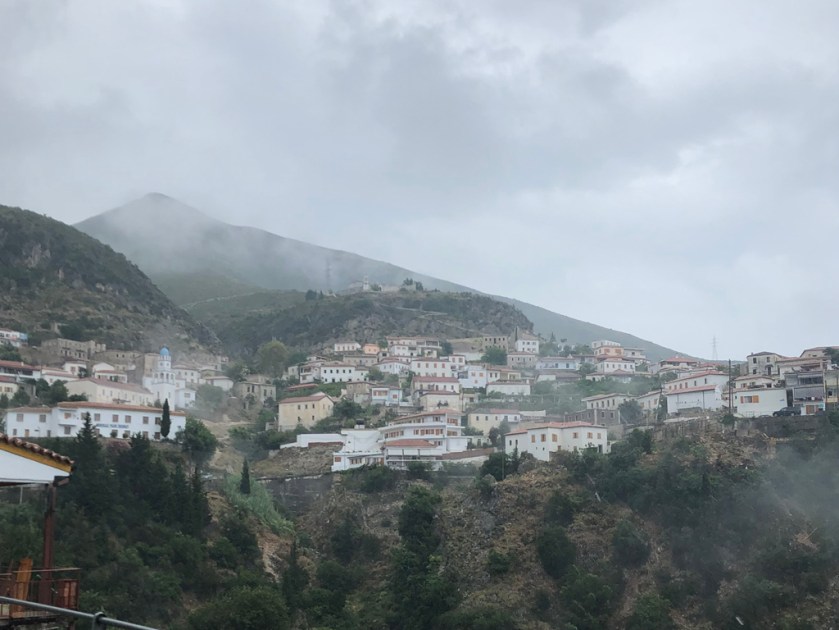
What we do see are quite a few bunkers, built during the communist government, nestled into the woods. Wikipedia tells us later that there is an average of 5,7 bunkers for every square kilometre in Albania, making it approximately 173’400 bunkers around the country.
We find a campsite south of Sarande in Ksamil. The place is definitely not worth mentioning, though I almost regret not having taken a picture of the ‘bathroom’. None of us feels like taking a shower there.


A little further south is Butrint, one of the most important archaeological sites in Albania. We visit the site in the late afternoon and enjoy the walk through these ancient walls, lying beautifully on a hill overlooking Lake Butrint and Vivari Channel, almost at the border to Greece. Inhabited since prehistoric times, Butrint has been the site of a Greek colony, a Roman city and a diocese. Following a period of prosperity under Byzantine administration, then a brief occupation by the Venetians, the city was abandoned in the late Middle Ages. The ruins on site witness therefore of many different periods, religions and typologies.


We leave the coast the next day and drive north through the mountains to visit another famous tourist attraction in Albania. Gjirokaster, which means “city of stones”, is a rare example of a well-preserved Ottoman town. The town is overlooked by Gjirokaster Fortress, which origins go back to the 1100s, but it’s been renovated and expanded multiple times in the following centuries. Perched at the summit of a hill, it overlooks an important route through the Drina valley and dominates the townscape.
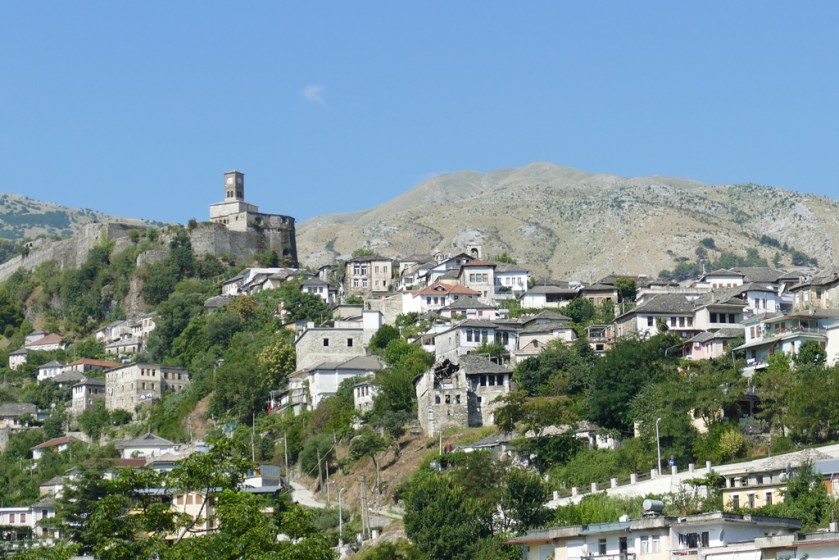
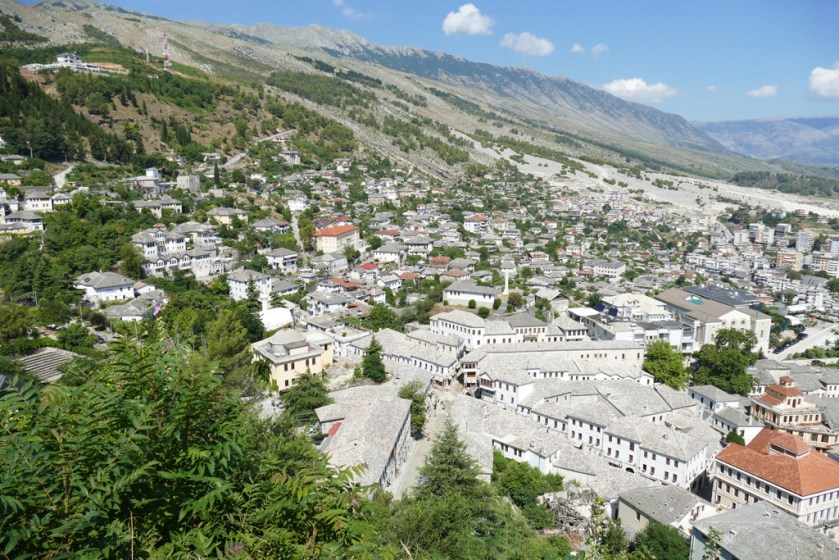 We start up on the fortress, getting an overview over the town and enjoying the magnificent sight in front of us. Houses, roofs and roads are all built in the same sand-coloured limestone and fit perfectly into the landscape.


We make our way back to the old town and wander through the narrow winding streets to the Old Bazaar where they are restoring the black and white sandstone pattern on the paved road.
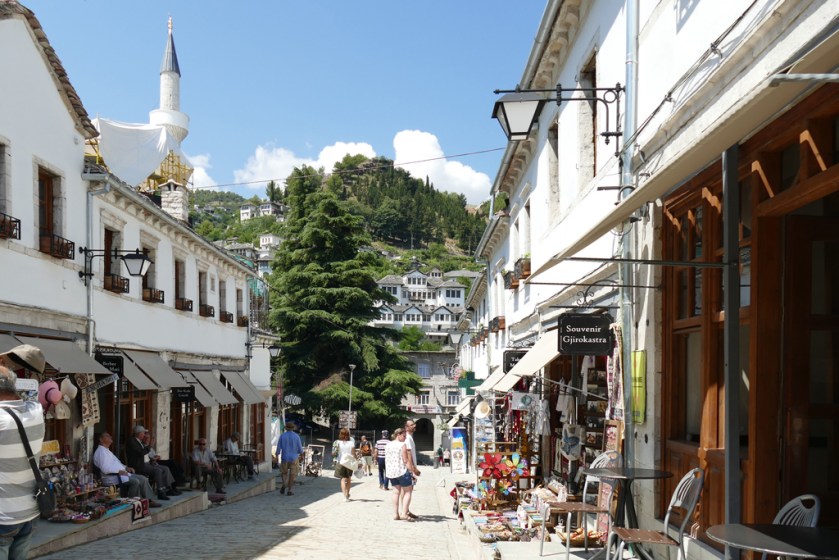


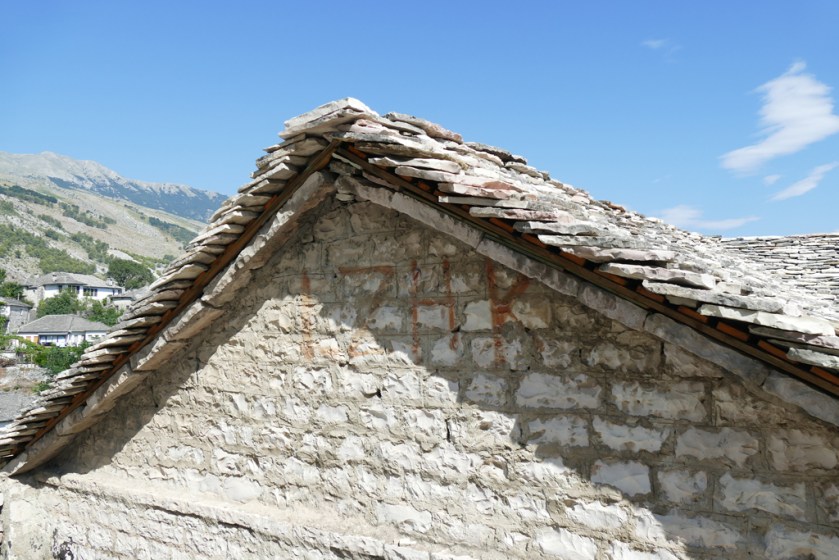
We admire many of the typical fortresslike houses, consisting of two parallel tall stone block structures which can be up to five stories high.


We visit two of them: the author Ismail Kadare’s house (refurbished recently after a devastating fire) and the Skenduli house, dating from the early 1700s with many fascinating features, including a room used only for wedding ceremonies and which has 15 windows, many with stained glass. After enjoying a Byrek for lunch – best I’ve ever tasted – we slowly make our way back to the car.

 After only a few days in Albania, we continue to Greece, well aware of the fact that we haven’t seen a lot of this country. Originally we had planned to travel to the mountains in the Northeast and also visit Lake Ohrid, but distances are simply to big. We therefore decide to head directly to the Meteora in Greece, our last stop on the way before we end up at my parent’s house on the Peloponnese.


Wow this sounds like such an adventure! Thanks for sharing this with us and keep up the great content.
LikeLiked by 1 person